Brain Monitoring Market Size, Share, Demand, Growth Report 2032

The global brain monitoring market was estimated to be worth USD 3524.16 million in 2023 and is expected to grow to USD 6,091.89 million by the end of 2032, according to a report released by Zion Market Research. Over the course of the projection period, the market is anticipated to rise at a CAGR of 6.27%.
✈👉Get a Free Sample: 🚀https://www.zionmarketresearch.com/sample/brain-monitoring-market
Introduction:
- Overview of Brain Monitoring:
Introduce brain monitoring as a crucial field in neuroscience and healthcare that involves assessing brain activity and functions using various technologies, including electroencephalography (EEG), functional magnetic resonance imaging (fMRI), and magnetoencephalography (MEG). - Importance of the Market:
Highlight the significance of the brain monitoring market in diagnosing and treating neurological disorders, understanding brain functions, and advancing research in neuroscience.
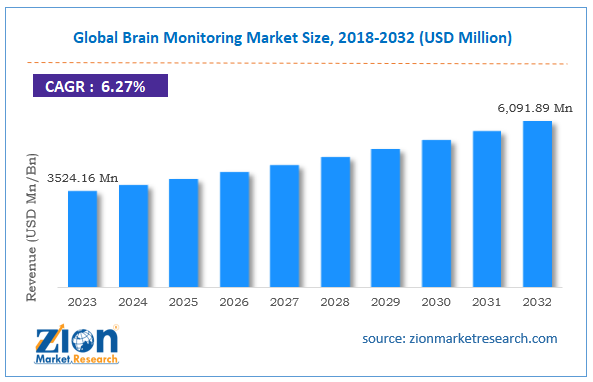
Overview of Global Brain Monitoring Market
Brain functions like blood flow, magnetic movement, cerebral oxygen capacity, electrical motion, gravity next to the brain, tumor, and other ailments are among the activities connected to brain monitoring. Severe symptoms include tremors, paralysis, loss of feeling, and discomfort and weakness in the muscles can result from these brain disorders. The illnesses linked to the brain are extremely complex, and treating them is also quite expensive. These days, a variety of brain monitoring tools are available to treat these illnesses.
Global Market for Brain Monitoring: Segmentation
Global market segmentation for brain monitoring includes product, end user, therapeutic application, process, and geography.
The brain monitoring market is divided into devices and accessories based on the kind of product.
The devices segment is further divided into sub-segments: transcranial doppler devices, cerebral oximeters, computerized tomography devices, magnetic resonance imaging (MRI), intracranial pressure monitors, magnetoencephalography devices, positron emission tomography devices, electroencephalography devices, and sleep monitoring devices.
The categories of accessories include type and usability. The market is further divided into electrodes, pastes and gels, cables, sensors, caps, batteries, and other categories based on the kind. The market is divided into non-disposable and disposable segments based on the level of usability.
The non-invasive and invasive segments of the global brain monitoring market are divided based on the procedure.
Epilepsy, Parkinson’s disease, dementia, Huntington’s disease, stroke, headache disorders, sleep disorders, traumatic brain injuries, and other therapeutic applications like autism, Williams syndrome, schizophrenia, Landau-Kleffner syndrome, attention-deficit hyperactivity disorder, depression, dyslexia, and sickle-cell disease are the categories into which the global market is divided based on therapeutic application.
The worldwide market is divided into diagnostic centers, hospitals, ambulatory surgery centers and clinics, neurological centers and institutions, ambulances, and other end users such home care settings and academic and research institutions based on the end user.

Growth Factors for the Global Brain Monitoring Market
The growing frequency of neurological illnesses brought on by a variety of causes, including changing lifestyles, shifting social contexts, and rising stress levels, is the primary driver of the global brain monitoring market. Brain tumors, multiple sclerosis, epilepsy, and Alzheimer’s disease are just a few of the illnesses that can be examined with brain monitoring equipment. Since there has been a significant growth in the number of people with these conditions in recent years, it is now one of the main factors driving the global market.
An additional reason propelling the global market’s expansion is the rise in cerebrovascular post-surgical accidents. Because of these incidents, hospitals are now in greater need of automated brain monitoring equipment to better understand the effects of anesthesia and sedatives. The shortage of qualified specialists, unfavorable reimbursement regulations, the high cost of sophisticated technology, and uncertainties about the diagnostic instruments’ accuracy are the factors impeding the growth of the brain monitoring market.
✈👉Directly Purchase a copy of the report with TOC: 🚀https://www.zionmarketresearch.com/toc/brain-monitoring-market
Market for Brain Monitoring: Report Scope

Regional Analysis of the Global Market for Brain Monitoring
North America dominates the global market for brain monitoring. A few of the factors driving this growth are the rising prevalence of sleep and neurodegenerative disorders, the robust distribution and sales network of neurodiagnostic companies, the availability of insurance coverage for brain monitoring techniques, and government investments in the neurosciences. In the future, the Asia Pacific region is expected to dominate the worldwide industry, as it is also an emerging market.
Market Drivers:
- Increasing Prevalence of Neurological Disorders:
The rising incidence of conditions such as epilepsy, Alzheimer’s disease, and traumatic brain injuries is driving demand for brain monitoring technologies. - Advancements in Technology:
Continuous innovations in brain monitoring technologies, such as portable EEG devices and improved imaging techniques, are enhancing diagnostic capabilities and patient outcomes. - Growing Investment in Neuroscience Research:
Increased funding and investment in neuroscience research from both public and private sectors are propelling the development and adoption of advanced brain monitoring solutions. - Rising Awareness and Importance of Mental Health:
The growing focus on mental health awareness and the need for effective diagnostic tools for mental health conditions are boosting the demand for brain monitoring technologies.
Market Restraints:
- High Costs of Advanced Technologies:
The significant capital investment required for high-end brain monitoring devices can be a barrier for smaller healthcare facilities and research institutions. - Regulatory Challenges:
Navigating complex regulatory frameworks for the approval of brain monitoring devices can delay market entry and innovation. - Shortage of Skilled Professionals:
A lack of trained professionals to operate advanced brain monitoring systems and interpret data can limit their effective use.
Market Segmentation:
- By Product Type:
- EEG Devices: Used for measuring electrical activity in the brain.
- fMRI Systems: Utilized for imaging brain activity by detecting changes associated with blood flow.
- MEG Systems: Employed for mapping brain activity based on magnetic fields produced by neural activity.
- Transcranial Magnetic Stimulation (TMS): A non-invasive method used for stimulating specific brain areas.
- By Application:
- Clinical Diagnosis: Utilization of brain monitoring technologies for diagnosing neurological disorders and mental health conditions.
- Research: Use in scientific research to understand brain functions and investigate neurological diseases.
- By End-User:
- Hospitals: The largest end-user segment requiring brain monitoring for clinical diagnosis and patient management.
- Research Institutions: Facilities conducting neuroscience research and clinical trials.
- Diagnostic Laboratories: Labs specializing in neurological diagnostics.
Regional Insights:
- North America:
The largest market, driven by advanced healthcare infrastructure, high prevalence of neurological disorders, and significant investments in research and development. - Europe:
A significant market characterized by increasing healthcare expenditure and a strong focus on neuroscience research. Countries like Germany and the U.K. are leading in market growth. - Asia-Pacific:
The fastest-growing region, propelled by rising healthcare investments, increasing awareness of mental health, and growing demand for advanced diagnostic tools. Countries like China and India are experiencing rapid growth in brain monitoring technologies. - Rest of the World (RoW):
Examine market dynamics in regions like Latin America, the Middle East, and Africa, where improving access to neurological diagnostics is becoming a priority.
Competitive Landscape:
- Key Players:
Discuss leading companies in the brain monitoring market, such as Philips Healthcare, Siemens Healthineers, GE Healthcare, and others. Highlight their product offerings, market strategies, and recent developments. - Technological Innovations and Collaborations:
Emphasize recent advancements, product launches, and partnerships that enhance the capabilities of brain monitoring technologies.
Future Outlook and Trends:
- Integration of Artificial Intelligence:
The incorporation of AI and machine learning into brain monitoring technologies will enhance data analysis, improve diagnostic accuracy, and optimize treatment plans. - Increasing Adoption of Wearable Brain Monitoring Devices:
The trend towards portable and wearable technologies is expected to drive demand for consumer-friendly brain monitoring solutions. - Focus on Personalized Medicine:
Advances in genomics and personalized healthcare are likely to influence the development of tailored brain monitoring solutions. - Telemedicine and Remote Monitoring:
The rise of telemedicine will facilitate remote brain monitoring, enhancing accessibility and patient engagement in their health management.
Conclusion:
Summarize the key trends and growth opportunities in the brain monitoring market, emphasizing drivers such as technological advancements, increasing prevalence of neurological disorders, and rising awareness of mental health. Highlight the potential for growth in emerging markets and the importance of addressing challenges related to costs and skill shortages.
✈👉Enquiry for buying: 🚀https://www.zionmarketresearch.com/inquiry/brain-monitoring-market
get to know better
Digital Printing and Dyeing Machine Market
Contact Us:
Zion Market Research212
USA/Canada Toll Free: 1 (855) 465–4651
Newark: 1 (302) 444–016611\
Web: https://www.zionmarketresearch.com/
Blog: https://zmrblog.com/


Comments
Post a Comment